Internal Demand Rates
Important Dates & Materials
Oct. 21 | Stakeholder Feedback due
Sept. 29 | New Bill Impact Requests due
Sept 21 | Materials Posted
Sept. 14 | Materials posted
- High Level Agenda (posted Sept. 16)
- 1 | Summary Deck of Analysis
- 2 | Economic Efficiency Analysis (Criteria 1A & 1C)
- 3 | Bill Impact Analysis (Criterion 4)
- 4 | Bill Impact Analysis Extended Appendix (Rates 2.2, 2.7, 1.5, 2.8)
- 5 | Data Centre Analysis (Criterion 6) (Posted Sept. 16)
- 6 | Controllable Load Rate Class Deck
Stakeholder Update | Sept. 14
- Several pre-read packages containing analysis for the session have now been posted. We encourage you to review them in advance, as discussions will build on this material. The analysis will not be presented in detail during the session.
- Additional data centre analysis will be shared prior to the session
- Organizations that previously requested bill impact analysis will receive updated results (for the assets already requested) prior to the session
- There will be an opportunity to provide written feedback after the stakeholder session by October 21
New Bill Impact Analysis Requests
Transmission customers may request an expected bill impact analysis of their own bills:
- Submit requests to ISOtariffredesign@aeso.ca by September 29
- Requests must come from an employee or officer of the transmission customer (the legal entity holding the SAS contract)
- For confidentiality reasons, the AESO cannot provide bill impact analysis directly to consultants or other third parties
- AESO will provide the analysis by October 5
- Customers wishing to share their analysis with consultants must do so themselves
Purpose & Scope
To determine how current rates for demand are (or are not) fulfilling performance expectations now or in the future and, with robust stakeholder input, design solutions that address prioritized deficiencies.
The following topics are in scope for this engagement:
- Rate class review (including self-supply, large load, and non-firm rates)
- Rate Demand Transmission Service (DTS) performance and potential redesign
- Rate Demand Opportunity Service (DOS) performance review
Although there will be overlap and interdependencies, the below topics are out of scope and will either be covered in other workstreams, or are being discussed as part of standalone engagements:
- Point of Delivery (POD) Charges – classification, allocation, and rate design
- Ancillary Service products, services, and associated fees
- Optimal Transmission Planning (OTP)
- Restructured Energy Market (REM)
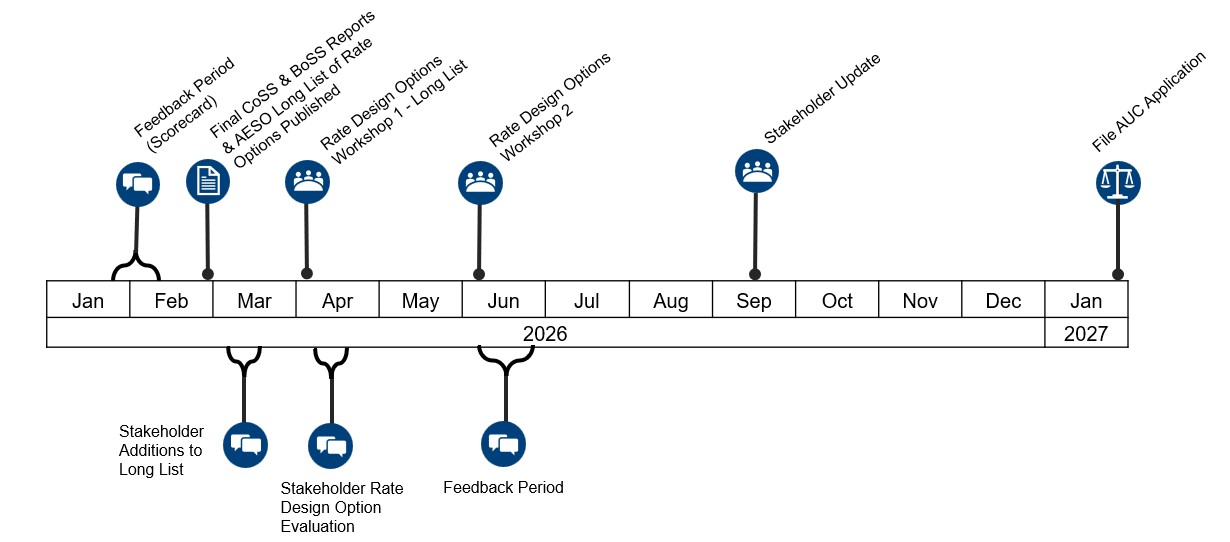
Engagement Schedule (Updated Jun. 30, 2026)
-
Purpose
We invite stakeholders to provide their feedback on the materials presented and discussion held during Internal Demand Rates Workshop 2 via the following stakeholder feedback form by end of day June 26.
Concise and focused feedback is encouraged. Thank you for your input.
Following Internal Demand Rates Workshop 2 held from June 2-5, 2026, we are inviting written comments from stakeholders on:
- Advancing rate design options, and
- The proposed terms and conditions for non-firm service offerings.
Please refer to the Workshop 2 presentation, and the Detailed Bill Impacts at Customer Cohorts Appendix to assist with your responses.
Instructions
- This feedback form is open to all industry stakeholders.
- Please submit your responses by clicking "Submit Feedback" below.
- Only one completed feedback form will be accepted per organization.
- Submissions due by June 26, 2026 and will be shared once received AESO Engage in their original format for review by all stakeholders.
- If you have any questions, please email stakeholderrelations@aeso.ca.
Stakeholder Questions
Rate Design options
During Workshop 2, we discussed which rate design options to study and refine in more detail. We categorized the main rate design options tabled during Workshop 1 in terms of likelihood to impact customer bills and promote efficiency improvements. Below is a very abbreviated summary (i.e., non-comprehensive summary) of what we heard during Workshop 2, in term of which rate design options to advance for further study and refinement:
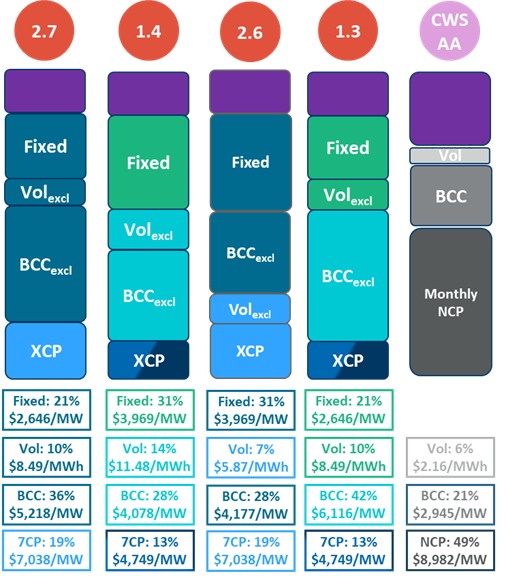
Category 1: Minimal Disruption
- 2.7 – studying how to recover the residual cost by spreading it over several billing determinants, to limit customer bill impacts and avoid behaviour distortions
- CWSAA option – studying efficiency gains or losses from moving from a primarily CP-based rate to an NCP-based rate
Category 2: Maximum efficiency (CP charge)
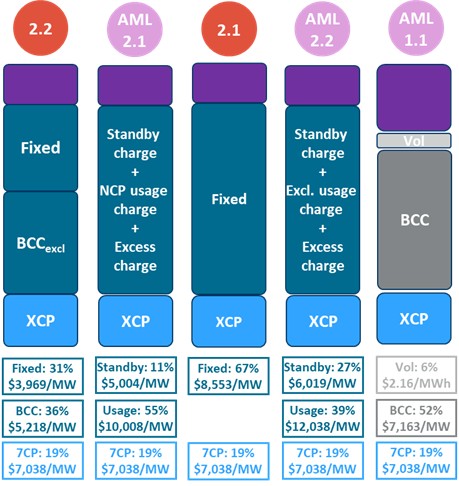
- 2.1 – including analysis of alternative billing determinants for the fixed charge
- 2.2 – including analysis of the allocation between the ‘access’ (i.e., fixed) charge and ‘usage charge’ (i.e., billing capacity charge variants and volumetric charge variants)
- One variant of 2.2 we will study is the ADC amended proposal XCP + BCCexcl + existing BCC
- We note that AltaLink Management (AML) revised its previous proposals to align with 2.1 and 2.2, asking the AESO/FTI to examine allocations and billing determinants, per above.
Category 3: Maximum efficiency (TOU charge)
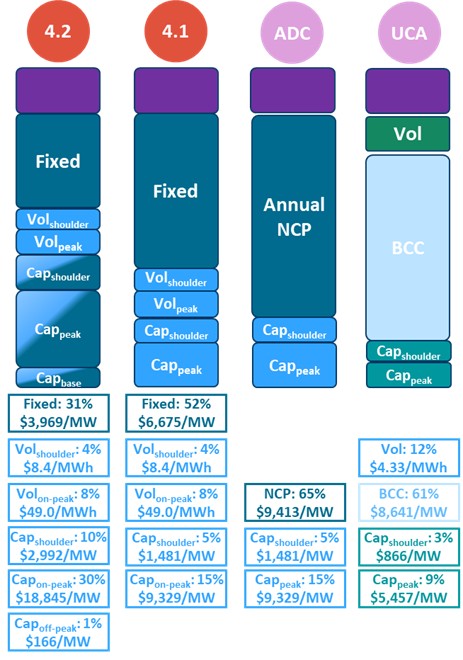
- 4.1
- We note that the Alberta Direct Connect Consumers’ Association (ADC) rescinded its TOU-based proposal, asking the AESO/FTI to study rate option 2.2 with modified billing determinants in conjunction with the declared capacity option.
- We note that the Utilities Consumer Advocate (UCA) advised that the analysis of the ‘UCA option’ did not comport with its intent and is therefore removed.
1. Does your organization agree that the five rate design options discussed above should be advanced for further study? Please explain why or why not.
2. To the extent that you do not agree with the previous question, please suggest alternative(s). (choose maximum 3 from any discussed during Workshops 1 and 2)
3. What should be the eligibility criteria?
4. Based on your response(s) from questions 1 and 2, please explain why your organization prefers those rate option(s). (e.g., particular elements of the rate option, the allocation of cost between elements)
5. Which rate option(s) would your organization propose we don’t pursue for further study? Please explain. (e.g., particular elements of the rate option, the allocation of cost between elements)
6. What one or two design features are “non-negotiable” for your organization? (supporting or opposing)
Design of the Coincident Peak (CP) Charge
During Workshop 2, stakeholders asked us to consider a CP charge without pre-defined months (see slides 312 to 317 of the Workshop 2 presentation). This would result in reduced cost reflectivity for some regions whose regional peak is generally unaligned with system peak, improved cost reflectivity for regions whose regional peak is generally aligned with system peak, with an overall reduction in cost reflectivity. It would also mean moving to type of annual billing cycle and have implications for those attempting to forecast and predict the coincident peak
7. Does your organization have comments on stakeholders’ proposal to move a CP charge without pre-defined months?
8. Please provide feedback on the declared capacity option (slides 198-248 of the Workshop 2 presentation), including the terms & conditions initially contemplated.
9. Based on information shared to date, would your organization consider using the declared capacity option? What additional information is required to advance the concept further (either to progress it or terminate it)?
Rate Demand Opportunity Service (DOS)
10. Please provide feedback on the proposed changes to Rate DOS (see slides 249-265 of the Workshop 2 presentation).
11. Does your organization have any additional Rate DOS revisions you would like us to consider?
Controllable Load
12. Please provide feedback on the Joint Renewable Generators Alliance, Energy Storage Canada & Enfinite proposal (slides 13-26 of Workshop 1 Consolidated Stakeholder Rate Design Option Proposals), and the terms & conditions initially contemplated (slides 233-248 of the Workshop 2 presentation)
-
Senior Tariff Design Analyst

-
Senior Stakeholder Engagement Advisor

Email claudia.moroianu@aeso.ca
-
 Stakeholder Session | Sept 21 & 23
-
 IDR Sept 23 presentation (Posted 23SEPT2026) (5.42 MB) (pdf)
-
IDR Sept 21 presentation (Posted 21SEPT2026) (6.28 MB) (pdf)
-
September IDR High Level Agenda (Posted 16SEPT2026) (173 KB) (pdf)
-
1 - Summary Deck of Analysis (Posted 14SEP2026) (2.54 MB) (pdf)
-
2 - Economic efficiency analysis (Criteria 1A 1C) (Posted 14SEP2026) (2.82 MB) (pdf)
-
3 - Bill Impact Analysis (Criterion 4) (Posted 14SEP2026) (3.09 MB) (pdf)
-
4 - Bill impact AnalysisExtended Appendix (Rates 2.2 2.7 1.5 2.8) (Posted 14SEP2026) (4.63 MB) (pdf)
-
5 - Data Centre Analysis (Criterion 6) (Posted 16SEPT2026) (3.44 MB) (pdf)
-
6 - Controllable load rate class (Posted 14SEP2026) (2.01 MB) (pdf)
-
Stakeholder Feedback Request (Posted 25SEPT2026) (5.23 MB) (docx)
-
-
Workshop 2 | June 1-5
-
IDR Workshop 2 Stakeholder Feedback Request Jun 8-26 2026(Posted 8JUN2026) (456 KB) (docx)
-
Workshop 2 Appendix – Detailed bill impacts at customer cohort level (Posted 8JUN2026) (10.3 MB) (pdf)
-
Workshop 2 Presentation (Posted 29MAY2026 Updated 5JUN2026) (20.9 MB) (pdf)
-
Day 1 - Initial Bill Impacts (pre-read) (Posted 25MAY2026 Updated 29MAY2026) (9.22 MB) (pdf)
-
Day 1 - Regional Rates Analysis (pre-read) (Posted 26MAY2026) (4.07 MB) (pdf)
-
Day 2 - Initial Bill Impact Metrics (pre-read) (Posted 26MAY2026) (3.24 MB) (pdf)
-
-
Workshop 1 | April 7-9
-
Workshop 1 Summary (Posted 14MAY2026) (220 KB) (pdf)
-
IDR Workshop 2 Stakeholder Feedback Jun 8-26 2026 (Posted 8JUN2026) (456 KB) (docx)
-
Scorecard (Fillable Excel) (Posted 17MAR2026) (51.3 KB) (xlsx)
-
Consolidated Stakeholder Rate Design Option Proposals (Posted 6APR2026) (4.34 MB) (pdf)
-
Workshop 1 Presentation (Posted 31MAR2026 Updated 9APR2026) (7.79 MB) (pdf)
-
Pre-read Materials for Rate Option Workshop 1 (Posted 17MAR2026) (2.51 MB) (pdf)
-
FTI AESO - Longlist of Rate DTS Design Options Report (Posted 17MAR2026) (6.86 MB) (pdf)
-
-
Scorecard Evaluation
-
Cost of Service Studies (COSS)
-
Cost of Service Studies Final Report (Posted 27FEB2026) (14.9 MB) (pdf)
-
Appendix 9 - Additional Analysis to Accompany Final COSS Report (Posted 27FEB2026) (4.44 MB) (pdf)
-
Cost of Service Studies and Scorecard Evaluation Directional Summary (Posted 27FEB2026) (360 KB) (pdf)
-
COSS Report Blackline (Posted 27FEB2026) (11 MB) (pdf)
-
ECOSS_MCOSS dataset (Posted 17DEC2025) (1.05 MB) (xlsx)
-
COSS Feedback Request - Dec 5 - Jan 21 (Posted 2DEC2025) (250 KB) (docx)
-
Cost of Service Study Stakeholder Presentation (Dec. 4-5 2025)(Posted 27Nov2025) (8.09 MB) (pdf)
-
AESO Cover Letter - Interim Draft Study Reports (Posted 17NOV2025) (224 KB) (pdf)
-
Cost of Service Studies - Executive Summary (Posted 17NOV2025) (421 KB) (pdf)
-
Cost of Service Studies - Interim Draft Report (Posted 17NOV2025) (10.2 MB) (pdf)
-
Cost of Service Study Announcement (Posted 9JUL2025) (304 KB) (pdf)
-
Internal Demand Rates Preliminary Consultant Statements of Work (Posted 14Mar2025) (150 KB) (pdf)
-
-
Benefit of Service Study (BOSS)
-
Benefit of Service Study Final Report (Posted 27FEB2026) (3.15 MB) (pdf)
-
Benefit of Service Study Directional Summary (Posted 27FEB2026) (256 KB) (pdf)
-
BOSS Report Blackline (Posted 27FEB2026) (2.9 MB) (pdf)
-
BOSS Feedback Request - Dec. 10 to Jan. 21 (Posted 9DEC2025) (241 KB) (docx)
-
BOSS Stakeholder Presentation (Dec. 10 2025) (Posted 27NOV2025) (5.59 MB) (pdf)
-
AESO Cover Letter - Interim Draft Study Reports (Posted 17NOV2025)
-
Benefit of Service Study - Interim Draft Report (Posted 17NOV2025) (3.46 MB) (pdf)
-
Benefit of Service Study Announcement (Posted 9JUL2025) (121 KB) (pdf)
-
AESO BoS Study - Methodology (Posted 9JUL2025) (1.23 MB) (pdf)
-
Internal Demand Rates Preliminary Consultant Statements of Work (Posted 14Mar2025) (150 KB) (pdf)
-
-
Hypothesis Statements
-
Presentations
-
Engagement Schedule

-
Workshop 2 Consolidated Feedback | June 8-26, 2026
-
Workshop 1 Consolidated Stakeholder Feedback (Posted 22AR2026 Updated 24APR2026) (3.22 MB) (pdf)
-
Scorecard Evaluation Consolidated Feedback (Posted 20FEB2026) (547 KB) (pdf)
-
Cost & Benefit of Service Studies
-
Consolidated Stakeholder Feedback on Draft Hypothesis Statements (Posted 4JUN2025) (497 KB) (pdf)
-
Consolidated Feedback - Mar. 5 to April 3 2025 (Posted 9APR2025) (437 KB) (pdf)
-
Consolidated Stakeholder Proposals (Posted 31MAR2026 Updated 9APR2026) (4.79 MB) (pdf)
-
Alberta Direct Connect Consumer Association (ADC)
-
AltaLink Management
-
Canada West Ski Areas Association (CWSAA)
-
Consumers Coalition of Alberta (CCA)
-
Energy Storage Canada
-
Industrial Power Consumers Association of Alberta (IPCAA)
-
Renewable Generators Alliance (RGA)
-
RGA, ESC & Enfinite Joint Proposal
-
Suncor
-
Utilities Consumer Advocate (UCA)